Every hunter knows that scouting for deer is important, especially if looking for more than just meat. Those looking for a trophy have to do more than just walk around in the woods before the season looking for sign.
The hunters that consistently take big bucks put in work to find the best possible location, and that work starts long before the season begins. In fact, most of them scout for deer throughout the year. That is actually what is required to take a trophy that isn’t mostly pure luck.
Unfortunately, a lot of hunters don’t really know where to start because of the increase in deer populations. Hunters don’t have to work or hunt hard to be successful. Many hunt the same stand every year, shooting does and decent bucks, with a few getting lucky enough to take a trophy. There is nothing wrong with this, but it doesn’t show that hunters are doing anything other than being able to sit quiet and still for a few hours. It’s hunting, but it is not trophy hunting. Luckily, proper scouting for deer isn’t that hard to learn. This means that hunters willing to do the work can turn hunting from luck to skill. In fact, technology has made it fairly easy, or at easier.
Before Heading In
In today’s technological world, no one should just walk into the woods randomly. There are just too many ways to observe hunting areas from above. Those who don’t want to spend the money on a hunting specific map app, such as onX Hunt, can use Google or Apple to view satellite and terrain views in addition to roads showing access.
Many states even have ownership data available online via GIS systems, helping hunters understand hunt area borders. This can also be a way to find new hunt areas, though asking to hunt a farm has become much more difficult in recent decades.
Satellite and topographical data allows hunters to view terrain, showing ridges, benches and funnel points. It can even show vegetation thickness, edges and even distance between likely points, such as feeding and bedding zones, for possible stand placements before placing leather on the ground. In fact, GPS data can even be extrapolated from some of the sites, putting hunters close to likely locations when scouting.
Those who prefer old school can still obtain topographical maps. These maps can be downloaded, or purchased, from the U.S. Geological Survey. Another good source is MyTopo.com, which allows users to customize topo maps for desired areas and have them printed on waterproof paper, or use the site’s online mapping software.
Lots of hunters use satellite, GPS and paper maps together, which is probably the best method. Smart phones lose signal, GPS units fail and both can lose power. As such, it is always smart to carry a paper topographical map in the pack or pocket.
Boots on the Ground
The next step when scouting for deer is getting a first-hand look at potential hunting areas. While wearing out boot leather will come into play, it is best to start with binoculars. Hunters can learn a lot about deer patterns by watching from a distance. This also reduces disturbing hunting areas, which can change patterns.
Not disturbing patterns is important when scouting for deer. For that reason, hunters should scout for deer just like they hunt, by washing clothes and body in scentless soap and covering gear with scent elimination spray. Also be sure to pay attention to wind patterns, just like when hunting.
Once in the woods, look for food sources, bedding areas and trails coming out of thick areas. Be sure to look for tracks, dropping and rubs, as well as scrapes even though most scouting occurs a bit early for fresh breeding sign. Also look for trail intersections, especially ones into funnel points or near food. Areas where trails come together greatly increase odds of seeing deer. It is after finding a few likely locations that technology, once again, comes into play.
Deer Scouting Technology
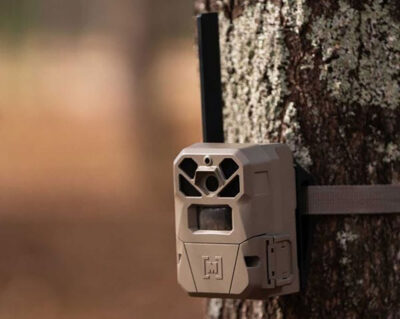
Game cameras have been around for a while, helping hunters scout for deer, turkey, hogs and more. They were, in fact, game changers when they came out back in the 80s. All of a sudden, hunters could watch deer without having to sit in the woods. One downside though, trail cameras required regular visits in the days of film. Digital cameras were a little better.
Today that is not a problem. Cellular game cameras let hunters sit in comfort as images of wildlife are sent directly to mobile devices. Some of these cameras, such as the Moultrie Edge 2 Pro, use Bluetooth and AI to make setup and control much easier. The best part of cellular game cameras, however, is being able to see what is in an area without disturbing that area to swap film or digital cards. Hunters only have to go in to swap batteries, which can last even longer than normal if using solar charging.
Cameras show time, temperature, location and direction, allowing hunters to pattern deer and other game. Hunters can put out a camera is every likely location or move cameras as needed. Trail cameras are the best way to scout for deer throughout the year, not just during hunting season.
Scouting for deer is the biggest factor for success that hunters can control. Sure, luck factors into hunting, but those who work harder are more likely to be consistently successful in the woods.