Getting Your Rifle Sighted & Ready for Fall (Or Long Range)
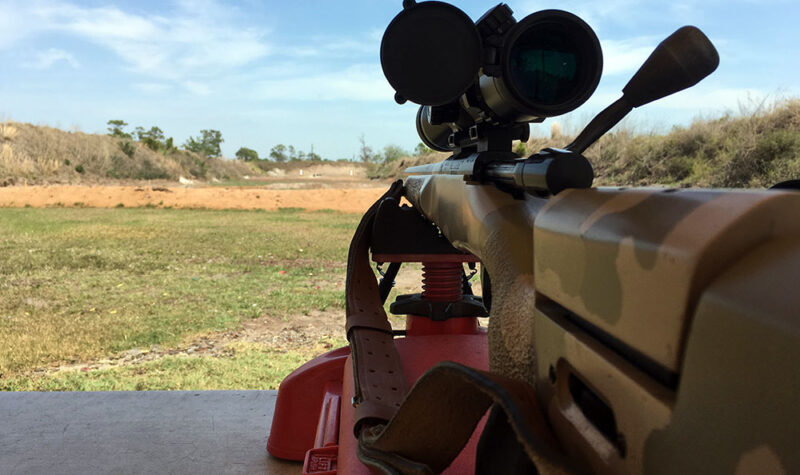
When I was 15, my dad gave me a Remington 742 Woodsmaster Carbine in .30-06 Sprg. It was my first deer rifle and second gun; my first was a Remington 1100 in 12 gauge. That rifle came with a small 4-power scope.
The next day, we went out with my uncle, who sighted the rifle by setting up a pie plate at around 100 yards. Freestanding, he put three shots in the plate and determined the rifle was ready for hunting. For the next few years, I would take the rifle out before season and put three in a plate to make sure it was still on.
As I got more into guns and shooting, I realized that hitting a pie plate at 100 yards didn’t mean the rifle was accurate or even sighted. Especially, if just standing or leaning against a tree. This is when I began my quest to learn about guns and shooting. One of the first things I went to learning was how to sight a rifle, which has changed quite a lot over the years.
Basic Rifle Sighting
I progressed to having a gunsmith boresight the rifle, or setting up a large target with a good rest at 25 yards. Both ensured being on paper. After sighting the rifle at 25 yards, I would move out to 100 yards and sight the rifle at one inch high.
Later, I would come back shoot another group, ensuring the point of impact matched the point of aim. I would do this multiple times if needed. This method pretty much allowed putting the cross hairs on a deer and hitting out to around 300 yards, with a little adjustment on the fly with the longer distances.
Now, there is nothing wrong with this method of rifle sighting. It has, in fact, worked for decades, with more advanced shooters doing it this way than are probably willing to admit. It is absolutely fine for the average deer hunter who seldom shoots much beyond 100 yards.
Rifle Sighting via Technology
I have lost count of number of rifles I’ve sighted in the above manner, and will still do again I’m sure. However, technology has changed almost everything, particularly sighting in rifles and long-range shooting.
Typically, I use a laser bore-sighter to get on paper at 25 yards without a shot, doing the same thing at 100 yards. I also use ballistic calculators, such as Ballistic AE, with exact load and velocity information to determine the bullet’s trajectory at every distance. This allows me to choose the best sight-in distance for the rifle and load. It also severely reduces the number of rounds needed to get a rifle sighted.
Seeing the trajectory on a screen will actually make you realize how little you really understood about how a bullet flies through the air. Ballistic calculators are especially accurate if you use a chronograph to obtain the velocity, along with other relevant information, rather than going by what’s listed.
Step By Step
- Line up the reticle at 25 yards using a laser bore sight.
- Sight the reticle at 100 yards using a laser bore sight.
- Fire three shots and fine tune reticle to desired point of impact.
- Use a chronograph with those shots to determine that box’s velocity.
- Enter the velocity into a ballistic calculator to determine the best zero for your purposes.
- Adjust sights to determined zero, firing groups if needed.
- Practice at lot at a variety of ranges.
Rifle Sighting Technology
Laser Bore Sights — Bore sighting has come a long way. Today, laser bore sights rule the rifle sighting world, with numerous models and styles. Two of the more popular types include cartridge and universal. Cartridge is exactly as it sounds; it fits into the rifle like a cartridge and fires a laser down the bore. Universals usually mount in the muzzle using interchangeable arbors, O-rings or expanding plugs to adapt to different calibers.
Chronograph —Ammunition comes with the velocity printed on the box. However, mass produced ammunition has a margin of error, particularly in batches. It might not matter at 100 yards, but could mean a miss at longer distances. Chronographs measure velocity for determining exact trajectory. Optical chronographs, such as the Caldwell Ballistic Precision, usually require more set up than radar chronographs but are also more affordable. The Garmin XERO and the Athlon Optics Rangecraft radar chronographs are extremely easy to use but cost three or four times more.
Ballistic Calculators—Most ammunition manufacturers have a free ballistic calculator on their websites. Some can even be downloaded to devices. These are typically designed around that company’s ammunition. They are actually quite good, and work for many people. However, independent apps, such as the Ballistic AE, seem to work better for most. Simply find the load, or enter in the velocity from a chronograph, along with other pertinent information to determine the trajectory. Other information that affects trajectory includes sight height, zero range, altitude, barometric pressure, temperature and more. There are places for that information in the calculators, with the Ballistic app calculating some of this automatically.
By Paul Rackley, GunBroker Editor