Why Jack O’Connor Still Matters to Modern Shooters and Hunters
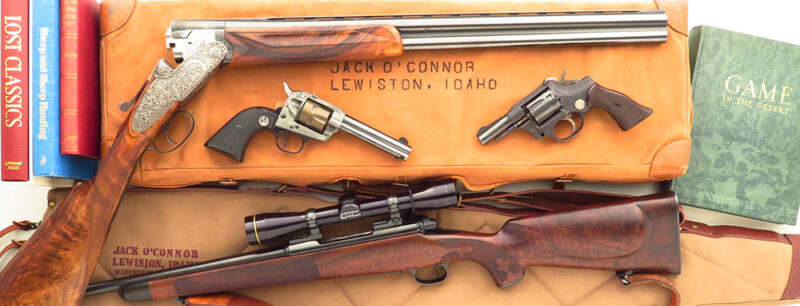
Editor’s Note: Jack O’Connor was one of the most renowned ol’time outdoor writers. Some of his personal guns, books and artwork have been listed on GunBroker. Not everyone might remember him, which is why our publisher decided to explain why Jack O’Connor matters.
There are gun writers, there are hunting writers and then there is Jack O’Connor.
Decades after his byline first appeared in the pages of Outdoor Life, O’Connor’s influence still echoes every time someone debates cartridge choice around a campfire or defends the idea that marksmanship matters more than muzzle energy. He did not just write about rifles and hunts. He shaped how generations of American shooters thought about them.
At a time when bigger was often equated with better, O’Connor was quietly making the case for precision, restraint and confidence in equipment. He believed deeply in knowing your rifle, trusting your dope and placing your shot where it mattered. That philosophy feels almost modern today, which is remarkable considering much of his work was penned when typewriters ruled and optics were optional.
The Writer Who Made You Care
Jack O’Connor’s prose was clean, confident and occasionally sharp. He could be opinionated without being smug. He was authoritative without being condescending. You did not just read his articles. You argued with them, nodded along to them or clipped them out and saved them. His battles with Elmer Keith over cartridges were legendary.
He wrote about sheep hunting in a way that made readers understand both the romance and the grind. Long climbs. Thin air. Missed opportunities. Hard lessons. His stories were aspirational but never dishonest. If a shot was long, he said so. If a decision was risky, he owned it.
That honesty built trust, and trust is the currency that turns a writer into a reference point.
The .270 Winchester Effect
You cannot talk about Jack O’Connor without talking about the .270 Winchester. The two are permanently linked, whether fair or not.
O’Connor did not invent the cartridge, but he turned it into a legend. He proved, repeatedly and publicly, that the .270 could humanely take game across North America and beyond when used correctly. It was flat shooting with manageable recoil. It also had excellent sectional density. These were not marketing buzzwords yet. They were field notes.
More importantly, he made shooters comfortable choosing efficiency over excess. In doing so, he challenged the idea that ethical hunting required the largest caliber available. That argument still plays out today in forums, gun shops and comment sections, often without people realizing they are reenacting a debate O’Connor settled decades ago.
A Legacy Built on Confidence
What O’Connor really sold was confidence. Confidence in your rifle, your abilities and that preparation mattered more than bravado.
He encouraged shooters to practice, learn trajectory and to understand wind. O’Connor also pushed shooters to accept responsibility for every round fired. That mindset aligns perfectly with modern conversations about responsible gun ownership and ethical hunting, even though he was writing long before those phrases became commonplace.
His influence shows up everywhere. This is especially true in lightweight mountain rifles and the enduring popularity of the .270. He believed that a hunting rifle should be carried easily and shot well rather than admired from a bench.
Why He Still Matters
Jack O’Connor still matters because the problems he was solving never went away.
Shooters today are flooded with choices. New cartridges promise flatter trajectories, while new rifles shave ounces and add features. New optics claim to fix bad fundamentals with better glass. Through all that noise, O’Connor’s core argument remains quietly disruptive: none of it works if the shooter does not.
He taught generations to think critically about equipment instead of chasing trends. He made readers ask why they wanted a certain rifle or caliber, not just whether it was popular. That mindset is timeless. Whether you are debating .270 versus 6.5 Creedmoor or walnut versus carbon fiber, you are standing in a conversation O’Connor started.
His influence also endures because he respected the reader. He never assumed ignorance, but he also never tolerated laziness. He expected shooters to do the work, learn their rifles and accept accountability for every trigger pull. That ethic feels especially relevant today, when responsible gun ownership is discussed as much in terms of culture as capability.
Collectors prize O’Connor’s books and firearms not only for their rarity, but for what they represent. These were not safe queens or shelf pieces. They were tools owned by a man who believed rifles should be carried, trusted and used with intention. Owning one is not about nostalgia alone. It is about buying into a philosophy that still holds up under modern scrutiny.
Jack O’Connor mattered because he elevated the conversation. He still matters because he would probably tell most of us to slow down, practice more and stop overthinking caliber charts.
And he would almost certainly still tell you the .270 Winchester is enough.