Dead Air/Ruger Partnership Brings Out RXD910Ti (Our Review)
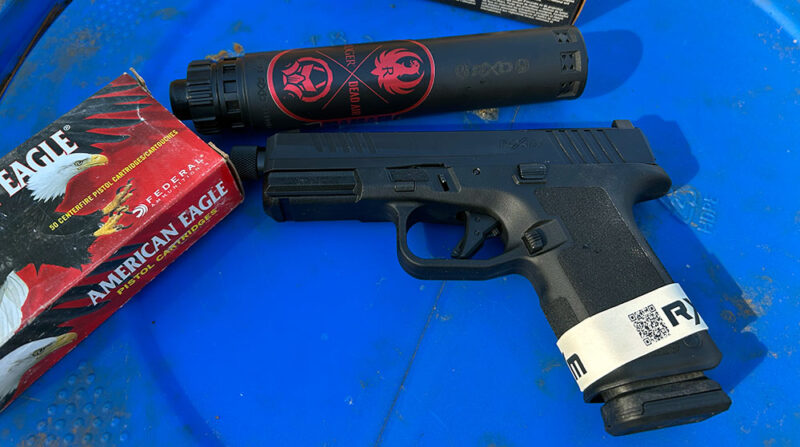
When creating Dead Air Silencers, the founders wanted to get away from standard mass-production. They wanted to use better materials to build better suppressors.
It didn’t take long for the company to get a reputation for performance with its Sandman series. They followed that success with the Mask silencer that set new standards when it came to rimfire suppression. Since then, Dead Air has continued its “no-compromise” approach to silencer design by partnering with Ruger for a new series.
In 2025, Dead Air Silencers and Sturm, Ruger brought out the RXD30Ti and the RXD22Ti, featuring new technology and designs. For 2026, the partnership has followed up with the RXD910Ti.
The RXD910Ti Suppressor
Dead Air used additive manufacturing to develop the RXD910Ti, creating what it calls the Triskelion Gas Management System. Basically, the company 3-D printed a continuous, one-piece baffle out of titanium. This method reduces overall weight (11.4 ounces with included piston) while increasing strength. The tube is also titanium, with an aluminum front cap that doubles as a flash hider.
While optimized for 9mm, the RXD910Ti suppresses multiple calibers. This includes 10mm, .300 BLK, .400 Legend and more. It’s even rated full auto with .300 BLK subsonic.
The design of the RXD910Ti reduces backpressure, via recoil-reducing ports on the front of the suppressor. These ports redirect gas from the central axis of the silencer to the muzzle of the suppressor, resulting in less felt recoil and faster follow-up shots. All this also helps with accuracy. Of course, there is only one thing that matters with a silencer/suppressor.
Results Matter Most
While the features and looks of a suppressor are nice, what really matters is sound reduction. And while no suppressor reaches the level of Hollywood imagination, technology has made them much better in recent years. Dead Air Silencers used this technology in the RXD910Ti, and it showed during testing. (All decibel testing was performed at an outdoor range with a handheld meter.)
I started with a threaded barrel Ruger RXM sans suppressor to get a baseline of sound on the decibel meter laying nearby. Each shot produced dangerous levels for ears. I then attached RXD910Ti with the included piston and fired from the same position with the same ammunition. The meter showed a sound reduction around 35 decibels and better. A second session, both with and without the suppressor, showed the same results.
I then broke out the Springfield Armory Kuna. Without a suppressor, this large-format pistol with its multi-port muzzle brake was loud. Adding the Ruger/Dead Air partner product lowered that sound by around 35 to 40 decibels. For comparison, I attached a Banish 46 and ran more rounds. The RXD910Ti won out by around five decibels, with some of it attributed to the RXD being optimized for 9mm, while the 46 handles larger calibers up to .45-70.
I then decided to run the same tests on the RXD910Ti with subsonic ammunition. Here, the little 7.7-inch suppressor really shined. Neither the Ruger nor the Kuna reached the mythical sound of a cough, but they sure got quiet. According to the meter, the silencer reduced sound, once again, by around 35 to 40 decibels. Since subsonic ammo is quieter to start, it really made a difference. In fact, the meter flashed rates under 85 dBs threshold for ear damage. It performed the same with the Kuna. The only problem was that the piston needed lubrication for the Ruger RXM to properly eject spent subsonic cases.
Oh, Those Results
The RXD910Ti performed as expected and advertised. It reduced sound down to a much safer level (completely safe with subsonic). While it is still recommended to wear hearing protection when shooting suppressed at the range, the RXD910 increases protection of the ears in situations where plugs or muffs are impractical, such as home defense.
It is especially effective on PDWs, whether braced-pistols, like the Kuna, or short-barrel rifles that are also part of the $0 tax stamp implemented Jan. 1, 2026. In fact, SBRs are where suppressors perform best. The combination of a stock with a short barrel allows attachment of a suppressor without being excessively long when working corners or doors.
Growing technology and changing laws are what has allowed companies to bring suppressors, such as the RXD910Ti, to where we are today. The days of a tube with some baffles are gone. Suppressor use has grown exponentially over the last few years and shooters expect these tools to become quieter and easier to use and maintain. They also want them to be cooler in use, but the technology is not quite there yet. Maybe that is the next thing to come?



![Ruger RXM Handgun: A New Era of Precision and Performance [Video]](https://content.gunbroker.com/wp-content/uploads/2025/04/Ruger_RXM-2-1200-x-800-400x267.jpg)
![SIG NEXT Suppressors: Making Quiet Count [Video]](https://content.gunbroker.com/wp-content/uploads/2025/06/HEXIUM762_HERO_LEFT-copy-400x235.jpg)