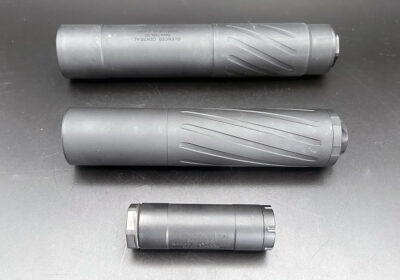
Your First Suppressor Part 1: What You Need Before Mounting a Can
Buying your first suppressor is exciting, but it can also be confusing. Unlike most firearm accessories, suppressors are not universal add-ons you can simply screw on and head to the range. Before you even choose a suppressor, you need to understand how it attaches to your firearm and whether your firearm is ready for one at all.
This first step is where many new buyers get tripped up. The good news is that once you understand the basics, the rest of the process becomes far more straightforward. As a side note, the terms suppressor and silencer mean the same thing. They are simply two names for the same thing.
Important Requirement: A Threaded Barrel
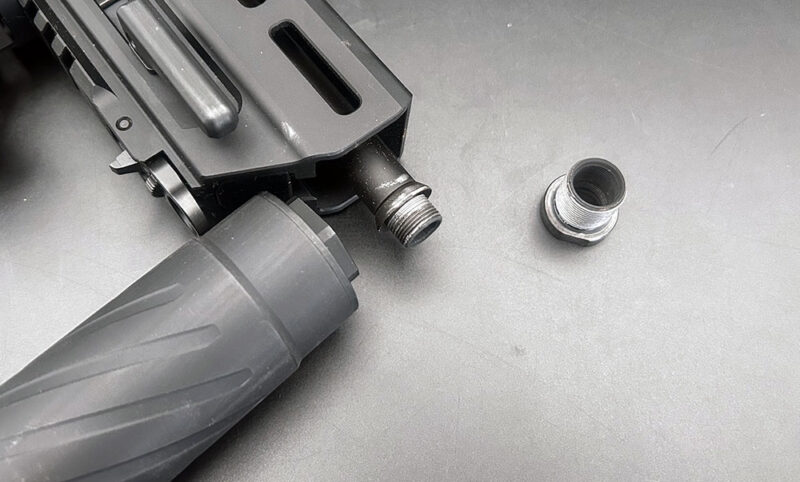
At its most basic level, a suppressor needs something to attach to. That means a threaded barrel.
If your firearm does not have a threaded barrel, you cannot mount a suppressor without first replacing or modifying that barrel. This applies to both rifles and handguns.
Threaded barrels come in different thread patterns depending on caliber and firearm type. Common examples include 1/2×28 for many 5.56 rifles and 9mm handguns, and 5/8×24 for many .30 caliber rifles. The exact thread pattern matters. It must match the suppressor mount or adapter you plan to use.
Most modern rifles ship from the factory with threaded barrels, usually covered by a thread protector. Handguns are more hit or miss. Some models are suppressor-ready out of the box, while others require an aftermarket barrel.
If your barrel is not threaded, a gunsmith may be able to thread it, but replacement barrels are often the cleaner and more reliable option, especially for pistols.
Direct Thread vs Mounts and QD Systems
Once you have a threaded barrel, the next question is how to attach the suppressor.
Some suppressors screw directly onto the barrel threads. This is the simplest attachment method and is common on rimfire suppressors and some entry-level rifle and pistol cans. Direct thread systems are lighter, less expensive and perfectly adequate for many casual shooters.
That said, many modern rifle suppressors use some form of mount, either adapter or quick-detach system.
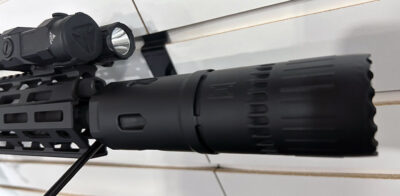
These systems typically involve a muzzle device, such as a brake or flash hider, that stays mounted on the rifle. The suppressor then locks onto that device using a proprietary interface. The advantages include faster attachment and removal, more consistent alignment and the ability to move one suppressor between multiple rifles equipped with compatible mounts.
For new buyers, the key takeaway is this: your suppressor choice often dictates your mounting system. Before you buy, make sure you understand what mounts are required and whether your firearms can accept them.
Why Handguns Need a Piston or Nielsen Device
Suppressing a handgun introduces an extra layer of complexity.
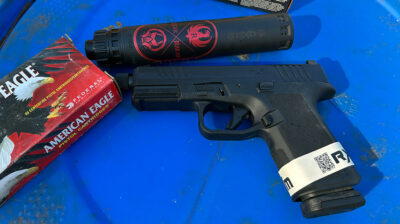
Most modern semi-automatic pistols use a tilting barrel design. When a suppressor is attached directly to the barrel, its added weight can interfere with the pistol’s ability to cycle. To solve this, handgun suppressors use a piston assembly, often called a Nielsen device or booster.
This spring-loaded system allows the suppressor to momentarily decouple from the barrel during firing, enabling reliable cycling. Without a piston, most semi-auto handguns simply will not function correctly with a suppressor attached.
It is important to note that pistons are caliber and thread specific. If you plan to use one suppressor on multiple pistols, you may need multiple pistons. This is normal and expected, but it is something new buyers often overlook.
Fixed-barrel handguns, such as some pistol caliber carbines and certain specialty pistols, may not require a piston. In those cases, a fixed barrel spacer is often used instead.
How Different Firearm Actions Affect Suppressor Use
Not all firearms behave the same way once a suppressor is attached. Understanding your firearm’s action type will help you set realistic expectations.
Bolt-action rifles are the simplest hosts. With no gas system and no moving parts during firing, they are inherently suppressor friendly. They tend to be quieter and place minimal stress on the suppressor.
Lever-action rifles also suppress well, especially when chambered in subsonic-friendly calibers. Gas leakage can occur depending on design, but overall performance is excellent.
Pump-action rifles function similarly. With no gas system, suppressor use is straightforward and reliable.
Semi-automatic rifles are the most common suppressor hosts today, however they introduce gas management concerns. Suppressors increase backpressure, which can affect reliability and increase wear. Adjustable gas systems, heavier buffers and tuned setups can mitigate these issues. New buyers should understand that suppressed semi-autos are a system, not just an accessory.
Evaluating Your Needs Before You Buy
Before choosing a suppressor, take an honest look at how you plan to use it. A casual shooter who plans to run a few magazines at the range a couple of times a month has very different needs than a high-volume shooter or someone running full-auto firearms. Suppressors are built from a range of materials, each with trade-offs.
Aluminum suppressors are lightweight and affordable. They are common in rimfire and pistol suppressors intended for lower heat and lower round counts. They are not ideal for sustained rifle fire.
Stainless steel offers greater durability and heat resistance. These suppressors are heavier and cost more, but they can handle higher round counts and more aggressive use.
Titanium balances weight and strength. It is popular for rifle suppressors intended for serious use without excessive weight. Titanium, however, comes at a higher price point.
Inconel and other superalloys are typically reserved for hard-use and full-auto-rated suppressors. These materials excel under extreme heat and pressure but drive costs significantly higher.
Understanding Price Differences
Entry-level suppressors designed for casual use often start in the lower price tiers. As materials improve and durability increases, prices rise accordingly.
Higher-end suppressors cost more not just because of materials, but because of engineering, mounting systems and long-term performance. For new buyers, the most expensive option is not always the right one, but the cheapest option may limit future use.
A good rule of thumb is to buy for how you realistically shoot today, with some room to grow. Suppressors are long-term purchases, and many owners end up wishing they had planned ahead.
The Foundation Matters
Mounting a suppressor is not complicated, but it is specific. Threaded barrels, proper mounts and compatible firearm actions are the foundation of a good experience. Get this part right, and everything that follows becomes easier.
In the next installment, we will walk through caliber selection and why chasing the quietest setup is not always the smartest approach for first-time buyers.