Reaping for Turkeys; An Effective Technique in Moderation
Over the years, I’ve done some unusual things to kill a turkey. This includes crawling through sand burrs in Oklahoma, running up a mountain in Colorado and swimming a cold creek in Mississippi. It took days to get the burrs out of my hands, I was pretty frozen by the time I got back to the truck, and this flatlander wouldn’t even think about running up a mountain today.
I’ve even tried reaping for turkeys, even though it is not my typical method. Some folks completely disagree with this method, though personally, I don’t have a problem with any method that is legal. Hunters just need to be smart about it. Reaping for turkeys can work. Reaping, or fanning, is, in fact, a popular method in some areas of the country. My first experience reaping for turkeys happened at the The Roost in Anselmo, Neb., and it was an eyeopener on the effectiveness of this method.
Reaping at The Roost
One of the first things the guides at The Roost told me was that calling wasn’t working right then. It was late in the season and birds were wary from pursuit. At that time, they were using fans to bring birds into range.
“Turkeys have excellent eyesight and can spot a potential rival from long distances,” said Duane Adams with The Roost. “The desire to breed and competition from rival toms makes this an effective tool.”
The concept was pretty simple. We would use binoculars to glass for birds. Once some were spotted, we would determine the best route to put ourselves into position for the toms to see the fan.
We couldn’t get around the first batch; they headed up and away before we could get set up. However, we got into a draw in front of the second group of three gobblers that were slowly working their way down. Right up until the guide held up and slowly turned the fan when they were about 150 yards away.
The first to see the fan charged, allowing me to drop it with a load of HEVI-Shot No. 6 from a Browning Cynergy Ultimate Turkey double-barrel at 15 yards. What was really surprising was that the shot didn’t spook the other two birds. In fact, the other shooter dropped a bird about 30 seconds after I pulled the trigger.
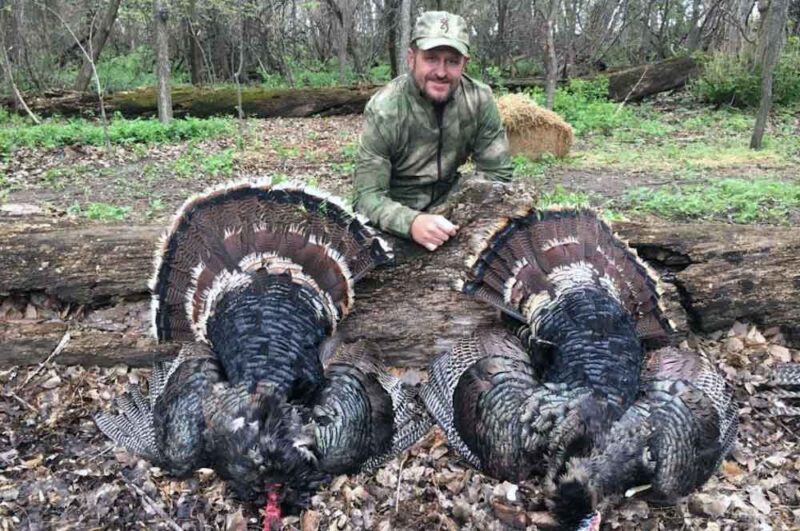
The final result was two birds, a Merriam’s and a hybrid, in two days, without making a single turkey sound. There was, however, some crawling involved. It was an interesting technique, of which I have used since but not exclusively. I kind of like going back and forth with a bird. A fan, however, can be the extra push needed to get a bird into range.
Doing it Right
While reaping for turkeys can be effective, it has its issues. First, a fan is another piece of gear that has to be carried. Second, safety must be paramount. A fan can look like a turkey to some hunters, especially in grass or foliage.
“This technique doesn’t lend itself to public land hunting due to the possibility of being mistaken for an actual turkey,” said Adams. “Also, this is simply an additional tool to use to help harvest a bird. Most importantly, learn woodsmanship and techniques to understand the birds and their environment.”
Reaping for turkeys works but it is best saved for rare occasions. Slowly turning a fan can bring a locked-up gobbler into range. If that doesn’t work, crawling toward the turkey behind a fan can sometimes give a hunter a shot. Just remember that a fan can make less-dominate turkey head the other way. Reaping for turkeys is a boss bird tactic with which hunters must be very careful.
Hunters should only reap for turkeys on private land with limited access from other hunters. Even then, hunters should use extreme caution, as some folks aren’t the best at paying attention. Be sure to listen for turkey sounds that don’t sound natural, as well as movement that could be another hunter.
Gear for the Hunt
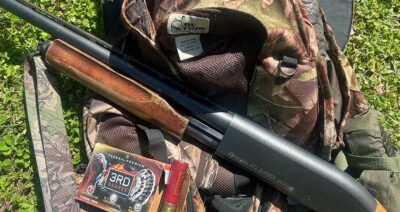
While any good shotgun will work for reaping, a turkey specific double-barrel, such as a Browning Cynergy, provides options. Two options, in fact, by using an extra full choke in one barrel and a modified or improved cylinder in the other. It worked well for me since I shot one bird at 15 yards and the other at 45.
And if you’re out travel hunting, you want to know that the ammo works. In today’s world, that means high-density, such as HEVI-Shot and TSS. I’ve been using HEVI-Shot since it was introduced. I’ve used TSS, and it might be better but it is definitely more expensive, and I’ve still got a few boxes of HEVI-Shot left.
The last thing needed for reaping for turkeys is a decoy. There are quite a few out there, but my guides at The Roost liked Montana Decoy, particularly the Wiley Tom 2D Gobbler Decoy. The company makes a decoy with reaper in the name, but the Wiley provides the option of using your own turkey fan. The guides claimed that a real fan made a difference.
I might also recommend knee pads, as reaping for turkeys can involve crawling, though that is recommended as a last resort. Still, I crawled quite a bit on my Nebraska hunt, as did my hunt partner. We both ended up tagging out on birds that were pretty much charging us, which is mostly a western thing, as it requires being able to see long distances, which the woods of the east often prevent.

![Federal Subsonic Ammo: 2026 Caliber Lineup Overview [Video]](https://content.gunbroker.com/wp-content/uploads/2026/02/FEDERAL_SUBSONIC-2-1200-x-800-400x267.jpg)
![Browning Citori 825 Shotgun Lineup Expands for 2026 [Video]](https://content.gunbroker.com/wp-content/uploads/2026/02/BROWNING_CITORI_825_SMALL_GAUGE_SPORTING-1-400x267.jpg)
![Browning B15: A Modern Custom Take on a Legendary Classic [Video]](https://content.gunbroker.com/wp-content/uploads/2026/02/Browning-B15-Featured-400x267.jpg)