Federal’s History of Crafting Turkey Loads, Then to Now
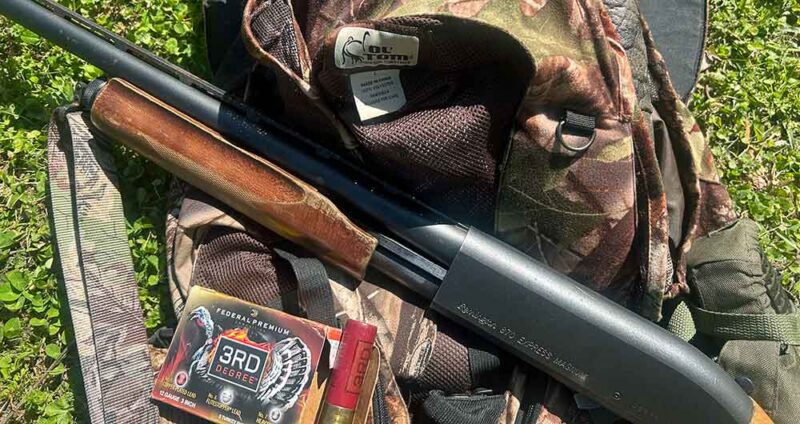
Modern turkey ammo offers performance benefits beyond what hunters had ever seen or dreamed of 100 years ago. But how did we get here? What were some of the events and products of the past that broke ground and helped lead the way to the better and more effective turkey loads of today?
Early Turkey Loads
Paging through old Federal Ammunition communications, sales sheets and vintage product catalogs revealed many interesting developments related to turkey hunting ammunition. Many of these moments helped shaped modern turkey loads.
Federal’s price list from 1926 shows the company recommending its most powerful 12-gauge loads (with 1 ¼-ounce shot) in shot size BB or No. 2 for wild turkeys. With that large shot size, hunters must have been aiming for body shots in those early days. These loads (named Hi-Power) featured paper hulls that were wound tight and waxed or varnished.
Shotshells through the 1940s stayed relatively the same, as new product development was mostly halted due to World War II. Through the 50s, a shell of this era still had a paper hull, a fiber base wad, card and cushion wad, and a roll-crimped closure with a top card wad.
Advancing Technology
Federal Ammunition introduced its first 2 3/4-inch magnum shotshell load in 1954. Magnum loads carried an increased powder charge and heavier shot payload. This made these turkey loads more powerful and hunters more successful. Then in 1957, Federal introduced a 3-inch super magnum shotshell. These were still paper-hulled.
Then, in 1965, Federal introduced the first extruded plastic hulls, which quickly became the industry standard. Plastic shells were easier and cheaper to produce and completely waterproof. Waterfowl and turkey hunters were quick to embrace this technology. Around this same time, a plastic wad cup started holding shot.
Federal recommended magnum loads for turkeys throughout the 50s, 60s, 70s and 80s, as shown by vintage product catalogs. These “Game Guides” recommended specific loads for turkey hunting. The game guide section in the 1975 catalog recommends Magnum or Hi-Power hunting loads in shot sizes BB, 2, 4, 5 or 6 for wild turkeys. One can only assume head shots were becoming more common.
Federal Premium
Federal launched its new Premium line of shotshells in 1977, promising first-class components with additional quality checks. It was advertised to match the quality of handloads. It quickly gained popularity with turkey hunters desiring the best.
Buffered shot showed up in the 1983 catalog. These tiny bits of material mixed in and loaded with shot pellets helped shot stay packed tight in the hull and tightened patterns. It also protected shot from deformation upon combustion of the powder.
Getting Closer
In 1988, a 12-gauge, 3 1/2 magnum load came out, giving more power to hunters who wanted to use a 12-gauge shotgun, instead of a heavy 10-gauge. Then, a decade later, tungsten-iron shot came out. This was the start of the next generation of high-performance turkey loads.
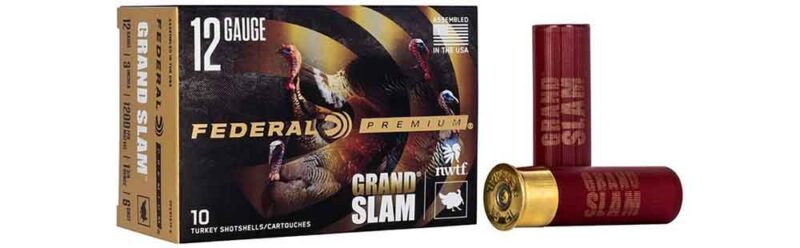
After this, Federal Premium announced high-energy turkey loads that provided more velocity than loads available in the past. Not long after, Federal introduced Premium Turkey Grand Slam loads in 10-, 12- and 20-gauge. These copper-plated lead loads were designed specifically for turkey hunting and are still standard in Federal’s lineup.
Next came FLITECONTROL wads and HEAVYWEIGHT shot, which changed the game. FLITECONTROL wads keep patterns tighter for longer range, and HEAVYWEIGHT tungsten shot was denser (15 g/cc) than other tungsten alloys offered in the past.
Almost There
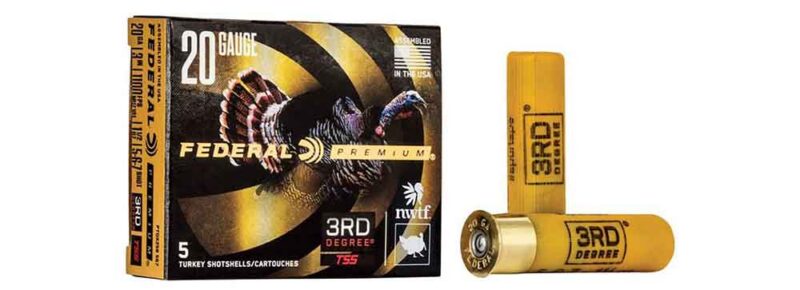
In 2015, Federal brought out its 3rd Degree turkey loads. These shotshells featured three different types of shot to deliver a versatile load that worked well on turkeys whether they were close, mid-range or long range. This was followed by improvements to its wad system. The FLITECONTROL FLEX wad, which patterned better in all types of chokes, was born.
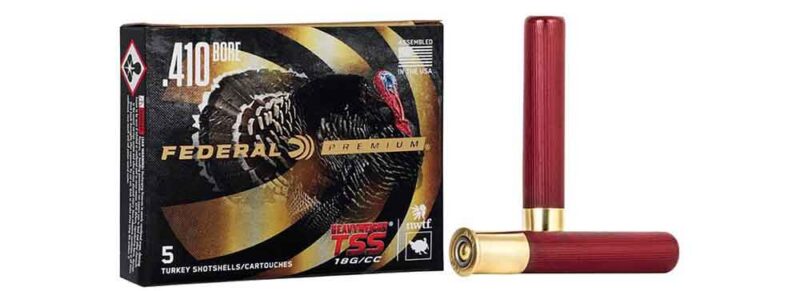
That same year, Federal introduced HEAVYWEIGHT TSS Turkey Loads. TSS is the densest (18g/cc) tungsten-alloy shot available. TSS even allowed the .410 bore to become effective for harvesting wild turkeys out to 40 yards. Federal began offering .410 TSS No. 9 loads for young hunters and those wanting to carry an ultra-light shotgun with a soft-shooting load.
Today’s Turkey Loads
Federal’s current lineup of turkey loads can be directly tied to products that came before them. These include Grand Slam, 3rd Degree, HEAVYWEIGHT TSS and Federal’s online Custom Shop TSS Shotshells.
Grand Slam shotshells represent the company’s classic turkey load. It uses copper-plated lead pellets that produce dense patterns and deliver ample energy. Also, buffering prevents pellet deformation for more consistent patterns.
Federal’s 3rd Degree turkey ammo features No. 7 HEAVYWEIGHT TSS shot, No. 6 FLITESTOPPER lead and No. 5 Premium lead, stacked in one load. The No. 6 lead pellets form a forgiving close-range pattern, the copper-plated No. 5 lead delivers lethal performance at mid-ranges, while the No. 7 TSS pellets allow dense, lethal patterns at 40-plus yards.
HEAVYWEIGHT TSS helps hunters kill gobblers farther than they ever thought possible. Payloads of No. 7 or 9 TSS shot provide high pellet counts—in many cases, more than double compared to lead loads of the same weight. Blended, duplex TSS shotshells combine No. 7 and No. 9, or No. 8 and No. 10 Tungsten Super Shot into new loads that deliver extremely high pellet-count patterns.
All these factory-loaded shotshells use Federal’s FLITECONTROL FLEX wad. This wad works with ported and non-ported chokes to maximize performance, opening from the rear and staying with the shot column longer than conventional wads to deliver full, consistent patterns.
Having History Helps
Shotshells started rolling out of Federal’s factory in 1922. Every decade since, Federal’s turkey load lineup has grown and evolved. This shotshell lineup didn’t happen overnight. It took a long time, adapting new technology, manufacturing processes, material sourcing and many other efforts for its product lineup to become the powerhouse it is today. Without the turkey loads of yesterday, we wouldn’t have the ultra-effective loads of today.
Over the past 100 years, Federal became well-known as one of the leading ammunition brands in the world. With strong leadership in the market and a continued commitment to new product development, the company will continue to remain at the top of the ammunition market. Who knows what it will inspire next?




![Federal Subsonic Ammo: 2026 Caliber Lineup Overview [Video]](https://content.gunbroker.com/wp-content/uploads/2026/02/FEDERAL_SUBSONIC-2-1200-x-800-400x267.jpg)