.30-06 vs .300 Win. Mag. Head-to-Head Ballistics
Have you thought about putting the .30-06 vs .300 Win. Mag. to learn which is better? While there are a lot of opinions out there, nothing beats straight numbers. Like all calibers, it depends on what you want to do with it. Since the .300 Win. Mag. and .30-06 Sprg. rifles are close cousins, it’s easier to do a head-to-head comparison.
In all the ballistics charts below, we used the same 180-grain .308-inch bullets. Both rifles were zeroed at 200 yards to keep things fair.
30-06 vs 300 Win Mag Basics
.30-06 Springfield
- Introduced in 1906 for military use.
- The name “.30-06” signifies “.30 caliber, 1906”.
- Based on a standard-length case design, with a rimless, bottleneck configuration.
.300 Win. Mag.
- Introduced in 1963 by Winchester.
- Based on a magnum-length case derived from the .375 H&H Magnum, shortened to fit standard long-action rifles.
- Designed specifically for greater velocity and energy.
Applications
.30-06 Springfield
- Ideal for medium to large game, such as deer, elk, black bear. Has also been used to take every big-game animal in North America, including moose and bison.
- Suitable for hunting and general target shooting.
- Historically used in military rifles (M1 Garand) and hunting rifles.
.300 Win. Mag.
- Better for long-range shooting and larger game (moose, grizzly bear).
- Often chosen for precision shooting, long-range hunting and sniper applications.
- Superior terminal performance at long distances.
Ammo Cost and Availability
.30-06 Ammo
- Generally more affordable and widely available.
- A large variety of factory loads and bullet options.
.300 Win. Mag. Ammo
- Typically more expensive due to larger powder charges and premium components.
- Slightly less common but still widely available.
Barrel Life
.30-06 Springfield
- Longer barrel life due to lower pressures and velocities.
.300 Win. Mag.
- Shorter barrel life due to higher pressures and velocities, especially with frequent shooting.
Side-By-Side

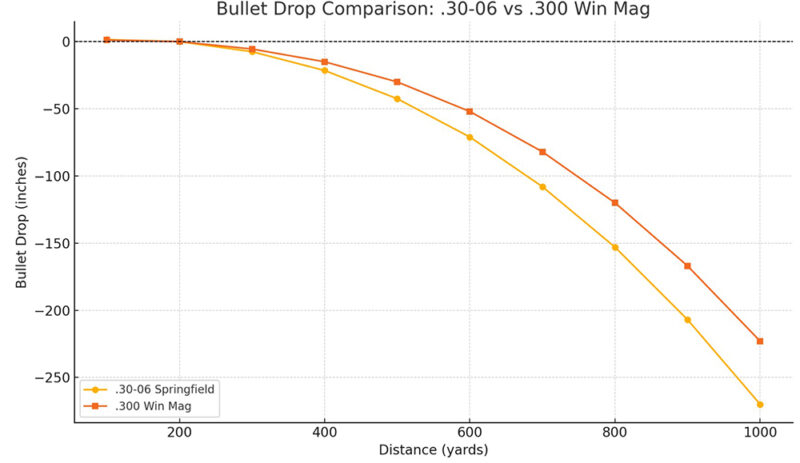
30-06 vs 300 Win Mag Bullet Drop and Energy Comparison Charts

Observations
- The .300 Win. Mag. demonstrates a flatter trajectory, particularly noticeable beyond 300 yards.
- The .30-06 has a steeper drop as distance increases, reflecting its lower velocity and energy compared to the .300 Win. Mag.
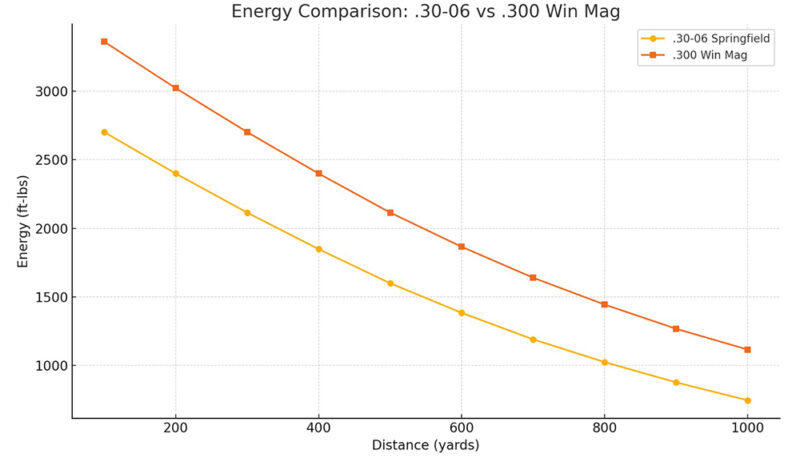
Observations
- The .300 Win. Mag. retains significantly more energy over longer distances due to its higher initial velocity and better ballistic efficiency.
- Both cartridges lose energy with distance, but the .30-06 drops below 1,500 ft-lbs. (a typical ethical hunting threshold for large game) at around 500 yards, while the .300 Win. Mag. maintains it out to approximately 800 yards.
30-06 vs 300 Win Mag Velocity Chart
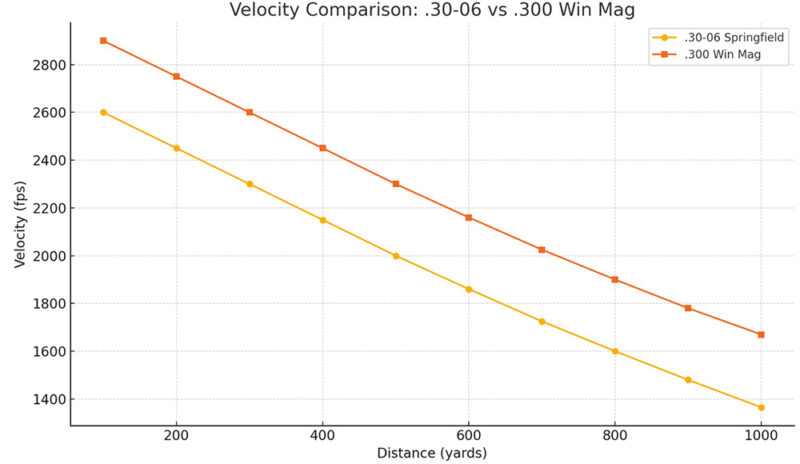
Observations
- The .300 Win. Mag. maintains higher velocity throughout its trajectory due to its greater powder charge and higher initial muzzle velocity.
- The velocity of both cartridges decreases over distance, but the .300 Win. Mag. shows less velocity loss, especially beyond 400 yards.
30-06 vs 300 Win Mag Recoil
For many shooters, recoil can be a deciding factor that makes or breaks which caliber they choose. The .300 Win. Mag. has much higher felt recoil than the .30-06. Using an average of an 8.25-pound rifle, we see the following:
.30-06 Springfield
- Recoil Energy: 20.3 ft-lb
- Recoil Velocity: 12.8 fps
.300 Winchester Magnum
- Recoil Energy: 25.9 ft-lb
- Recoil Velocity: 14.0 fps
This shows how dramatic the difference in recoil can be between the two calibers. For recoil-sensitive or smaller-framed shooters, the .30-06 wins out on this one. Higher recoil can also lead to bad habits like flinching or pulling the shot. This is why a .22 caliber rifle is such a perfect training and practice tool for instilling good shooting habits.
To mitigate the recoil, thicker butt pads and muzzle brakes can be used on a .300 Win. Mag. In the field, the most common solution is a heavier rifle. The only problem is lugging it around when compared to the lighter option of a .30-06. That comes down to the hunter’s tolerance, endurance and level of fitness in the real world.
Summary
Overall, the answer boils down to what your individual needs are when you’re picking the right rifle caliber for you. Many people find that the .30-06 meets their needs for big-game hunting. However, either cartridge works well in the field. It is important to consider ethical range and shot placement. Long-range and precision shooters are far more likely to prefer the .300 Win. Mag., where it’s pretty much unheard of to see a .30-06 on anyone’s bench. No matter which one you choose (or both), you can find thousands of listings for ammo, rifles and accessories on GunBroker.