The Wizard Drill (Realistic Test for Concealed Carriers)
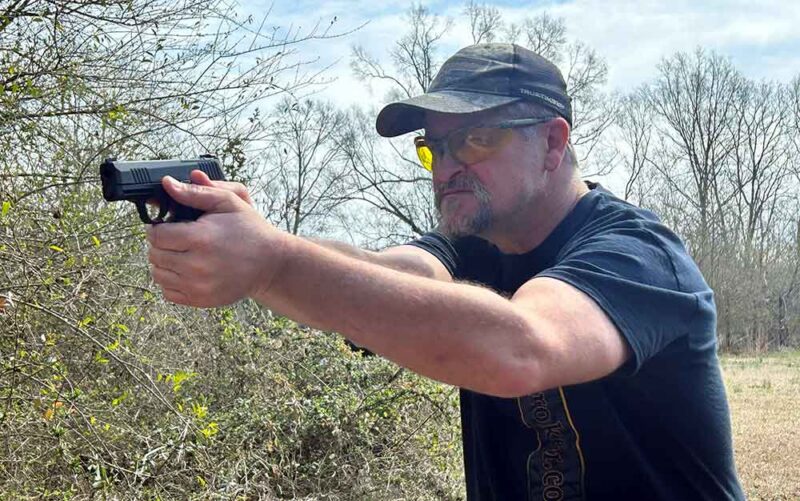
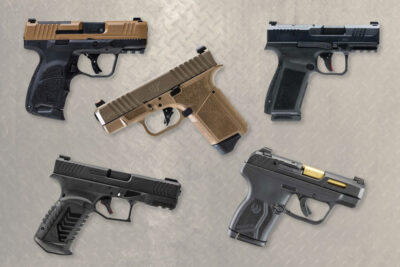
There are many benefits to carrying a larger handgun, such as more control and defensive rounds. They are also easier and more fun to shoot. However, larger guns, such as 1911s, G19s and Model 66s are also more difficult to conceal. This is why many folks carry compact and subcompact guns; they’re just easier to carry and conceal.
However, many of these same folks don’t train regularly with these smaller guns. This is a mistake, as smaller handguns are much harder to control and shoot accurately than larger guns. I’m as guilty of this as much as anybody, as a lot of my shooting revolves around testing. I typically only shoot smaller guns when I’m testing smaller guns, which I’m currently doing.
This subcompact gun test got me thinking about how I sometimes carry a subcompact pistol. Usually, I do this as a backup but sometimes I carry a little Ruger LCP as primary, especially during warmer weather. With spring around the corner in most of the country, I decided to brush up on my little gun skills at the range. This included one of the best small-gun tests, the Wizard drill.
The Wizard Drill
Ken Hackathorn developed the Wizard drill to be a practical test of gun skills. It is short, quick and revealing, and requires only five rounds and a shot timer, though a buddy with a stopwatch might work. It is also a whole lot more difficult than most realize. Now this drill wasn’t specifically designed for pocket guns. It is for whatever gun one regularly carries. However, folks who carry a pocket gun should really consider shooting the Wizard drill with their carry gun. It has been a while, so I ran the Wizard with three different pistols (more on that later).
The Wizard is meant to be shot from retention. This means shooters should use their everyday gun and holster. The drill tests whether a shooter can be effective in the real world, so perform it like the real world. Those using a pocket gun, however, can start with the hand on the gun. The whole point of a pocket pistol is being able to have a hand on the gun without people knowing.
Start facing an IDPA or similar target at 3 yards. At the signal, draw and fire one round at the head using the strong hand only. Move to 5 yards, drawing and firing one round at the head using both hands. At 7 yards, draw and fire one round at the head with both hands. Finally, at 10 yards, put two rounds in the body with both hands. All sessions begin at the beep of the shot timer.
To pass, each stage must be completely inside of 2.5 seconds. A full miss means failure. Take one point off for each hit outside of the head or chest circle/square, with two points of deduction also meaning a fail.
A pass means that there is a good chance of surviving an encounter with the gun and rig used. This includes a pocket gun, for which this drill is one of the best.
My Results
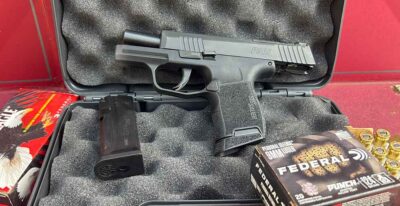
Since I haven’t run the Wizard drill in a while, I decided to give it a try with three different pistols. First, I used my current carry rig, a Ruger RXM in a Galco KingTuk Air Cloud. Next, came a SIG Sauer P365 that I’m currently testing, followed by the Ruger LCP that sometimes rides primary. I used pocket holsters for the P365 and the LCP.
I had no issues passing the Wizard drill with the Ruger RXM. All shots hit inside the circles within the time restraints. I will admit, though, that my first-run time on the 10-yard stage came in at 2.41 seconds. I was significantly faster on subsequent runs.
The P365 also ran well. There were zero issues hitting the target within the time limits until the last stage. At 10 yards, the time came in at 2.62 seconds on the first try. I wasn’t surprised by this since the 7-yard stage took 2.45 seconds, according to my shot timer. My second try secured a pass.
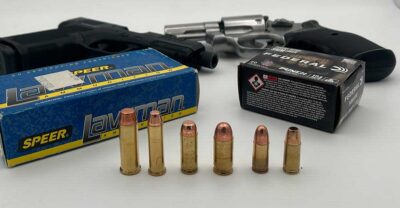
The Ruger LCP was, of course, the hardest with which to pass. In fact, my first shot was a miss because I had forgotten about the long trigger pull of this pistol. Unfortunately, I also failed during the second and third tries, but because of time, not accuracy. I did fine at 3 and 5 yards; it was the 7 and 10 that kept giving me trouble. I was hitting the target, it was just taking me too long to do it. On the fourth try, I passed the Wizard drill and just got faster the more I practiced.
The Whole Point
The Wizard is both a drill and a test. And it is a good one. It is practical to the real world, and it shows shooters where they need to improve, as it did for me. I did fine with my standard everyday carry gun. However, it showed that I need to spend more time with the backup that occasionally becomes primary.
I’m probably not the only shooter who sometimes overlooks training with smaller guns. They’re not really the most fun to shoot. However, those who choose smaller everyday carry guns need to train with those guns, and the Wizard drill is a good place to start. In fact, I think I’m going to run the Wizard from my BUG position and see what I get. It might be interesting to find out.