Your First Suppressor Part 4: Caliber Ratings & What They Mean
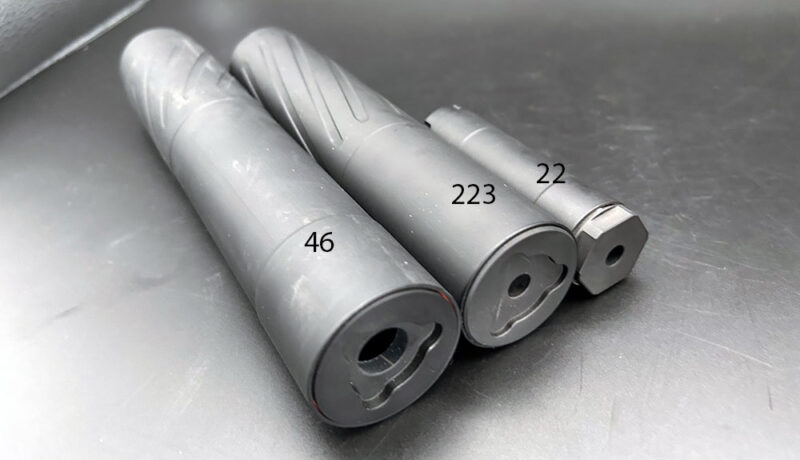
Caliber is one of the first things people notice when shopping for a suppressor. It is also one of the easiest things to misunderstand. Terms like .22, .30 caliber and .46 caliber are often used casually, but they do not always mean what new buyers think.
Understanding suppressor caliber ratings will help you choose the right suppressor and avoid costly mistakes.
What Does a .22 Suppressor Really Mean?
When people hear .22 suppressor, they often assume it refers to any firearm chambered in .22 caliber. In suppressor terms, that is not correct.
A .22 suppressor almost always refers to a rimfire suppressor designed for .22 Long Rifle. These suppressors are built specifically for low-pressure rimfire cartridges and are typically used on .22 LR pistols and rifles.
Rimfire suppressors are usually user serviceable because rimfire ammunition is dirty and deposits lead and carbon inside the suppressor. They are also built from lighter materials because they do not need to withstand high pressures.
A .22 rimfire suppressor is not suitable for .223 or 5.56 rifles, even though the bullet diameter is similar. The pressure difference between rimfire and centerfire cartridges is massive. Using a rimfire suppressor on a centerfire rifle would be unsafe.
Rimfire vs Centerfire Explained
Centerfire and rimfire refer to how the cartridge is ignited, but in suppressor terms, the distinction is about pressure and construction.
Rimfire suppressors are designed for cartridges like .22 LR, .22 WMR and .17 HMR depending on manufacturer ratings. They are not built to handle centerfire rifle pressures.
Centerfire suppressors are designed for higher pressure cartridges and are typically not user serviceable. They rely on sealed construction and stronger materials to manage heat and gas.
This distinction is why a .22 rimfire suppressor is its own category and not interchangeable with centerfire rifle suppressors.
What Does .30 Caliber Mean?
A .30 caliber suppressor refers to the maximum bullet diameter it is designed to handle. In most cases, this includes cartridges such as .308 Winchester, 7.62×51 and similar .30 caliber rounds.
Because of the larger bore and stronger construction, .30 caliber suppressors are often used on smaller calibers like 5.56. This is one of the most common multi-caliber suppressor setups.
The advantage is flexibility. A single .30 caliber suppressor can cover multiple rifles with different calibers. The tradeoff is that it may not be quite as quiet on smaller calibers as a dedicated 5.56 suppressor.
For many first-time buyers, a .30 caliber suppressor is a practical entry point that allows one purchase to serve several rifles.
Why Bigger Bores Are Not Always Better
While using a larger suppressor on smaller calibers is common, there are limits.
A suppressor must be rated for both the bullet diameter and the pressure of the cartridge. Just because a suppressor has a larger bore does not mean it can safely handle every cartridge below that diameter.
Always verify the manufacturer’s caliber ratings and firing schedule. Bore size alone does not tell the full story.
Why You Need a .46 Caliber Suppressor for .45-70
This is where many new buyers get confused. The .45-70 Government fires a bullet that is approximately .458 inches in diameter. A suppressor must have a bore large enough to allow that bullet to pass safely without contacting the internal baffles.
That is why suppressors rated for .46 caliber exist. The rating refers to the maximum bullet diameter, not the cartridge name.
A .45 caliber pistol suppressor is not designed for .45-70. Pistol suppressors are built for handgun pressures and velocities, not large bore rifle cartridges. Attempting to use one would be unsafe.
Large bore rifle suppressors designed for cartridges like .45-70 use heavier construction and larger internal volumes to manage both bullet diameter and gas pressure.
Caliber Names Can Be Misleading
Suppressor naming conventions are shorthand, not universal rules.
A .22 can almost always means rimfire, while a .30 caliber can means centerfire rifle. However, a .45 pistol suppressor is not the same as a .46 rifle suppressor.
Understanding these distinctions helps buyers avoid incorrect assumptions and ensures they choose suppressors that are safe and effective for their intended firearms.
Choosing Caliber with Flexibility in Mind
For first-time buyers, choosing a suppressor that covers multiple calibers can make sense. A .30 caliber rifle suppressor or a multi-caliber pistol suppressor can provide flexibility and value.
At the same time, specialized suppressors exist for a reason. Dedicated rimfire suppressors are exceptionally quiet. Caliber-specific rifle suppressors often deliver better performance.
The right answer depends on your firearms, your shooting habits and how many suppressors you plan to own over time.
Suppressor caliber ratings are not marketing fluff. They are safety boundaries. Understanding them is one of the most important steps in becoming a confident suppressor owner.


![SIG NEXT Suppressors: Making Quiet Count [Video]](https://content.gunbroker.com/wp-content/uploads/2025/06/HEXIUM762_HERO_LEFT-copy-400x235.jpg)