Seeing in the Dark: Using Thermals for Hogs
Hunting hogs is challenging. Hogs are much better at seeing and hearing you than hunters are at surprising them. When you do, you’d better be able to aim and hit properly or you’re faced with tracking a wounded boar. There are several ways to create an advantage, including using modern thermals for hogs.
Thermal optics, once incredibly pricy and hard to find, are now available on the civilian market and reasonably priced. Using these devices for hogs is also incredibly fun.
Thermals for Hogs Setups
I used two different thermal scopes to provide success in rapidly finding and fixing both sounders (groups of hogs) and single boars at night. In Georgia, I used a Pulsar Thermion XG50 3-24×43 Thermal riflescope on a Faxon 8.6 Blackout Sentinel rifle with a 16-inch barrel.
During a hunt in Florida, I used a Spikes Tactical 5.56 AR with a 17-inch free-floating barrel shooting Black Hills 62-grain TSX hunting ammunition. The Spikes AR was topped with a LEAP 6 Thermal scope from RIX.
As with any optic, the key to accuracy is properly sighting-in the sight. Modern thermal optics are designed to be zeroed with one shot. This gets even easier using a laser sighting device.
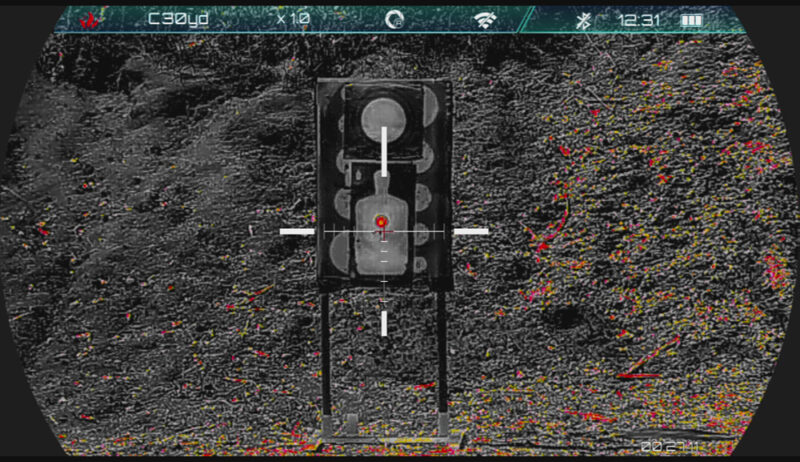
At home I bore sighted my newly mounted LEAP 6 with a laser at 30 yards away. Since thermal scopes don’t “see” reflected laser light, I hung my morning coffee’s K-cup pod on the bullseye; it shone like a beacon through the thermal optic.
When I went to verify my zero at 100 yards, I used one of the several thermal targets that RIX provides with thermal optics. They are exothermically hot 6×6 cm adhesive patches that stick to a target. I used the same in Georgia to verify zero on a Thermion scope placed on my 8.6 Faxon Sentinel.
Guide or No Guide

Now, a lot of people want to know if they should use a local guide? There’s lots of places where the hogs are rampant, and farmers would really like the destructive sounders thinned out. A local guide optimizes time by knowing where the hogs are located.
While hunting near Wauchula, Fla., the group was guided by Lorne Twist. The four of us spent little time finding a 350-pound trophy boar in total darkness.
In Georgia, my guides were Army Infantry Veteran Jack Calhoun and Joseph Parker. Using pickups to get around, we bagged a running coyote before finding a sounder of 30 hogs tearing up a farmer’s field. Picking out a 300-pound boar with long tusks, we stalked for a few hundred yards and stopped when the herd started to get restless. At about 100 yards the big boar paused long enough for a steady shot. The 300-grain 8.6 put him down, all clearly seen in my thermal scope.
During my Florida hunt with Lorne Twist, we used our thermal optics to spot a big heat source that turned out to be a very large boar. We stalked as close as we dared to about 75 yards of the boar.
The LEAP 6 clearly showed the hog’s movements and shape including the head. It also showed it was getting restless and ready to bolt. I waited until I had a clear, head-on shot with the crosshairs centered on the chest. We cautiously approached, keeping the hog in view with the thermal scope until we were close enough to use white light. The boar was a big one, well over 300 pounds, with vicious tusks.
The shots proved that the thermal sights were superb in locating, identifying and providing a target solution. It then delivered precise and accurate placement as good or better as any analog telescopic sight.
Other Thermal Options
Other excellent thermals for hogs options are the Holosun DRS Thermal, a multi red-dot optic that combines red-dot technology with thermal imaging. The DRS-TH uses a Picatinny base and features an LED MRS (Multi-Reticle System) with two reticle options and five thermal image modes.
For just observation is the AGM TM50-640 Sidewinder Thermal monocular that detects man-sized objects at over 2,500 meters. The image is projected onto a 1024×768 resolution OLED display screen viewable with four distinct color palettes to adapt to various environments. But just how does that amazing thermal technology work?
The Workings of Thermal
Although it looks like an optical telescopic sight, a thermal optic is closer to a computer than an optical sight. Most thermal optics can record and even transmit pictures and video via Wi-Fi and Bluetooth. The LEAP 6 also features a 1920×1080 resolution LED display, optical and digital zoom and multiple reticle options. When sighting in, the X and Y changes are input into the device and saved for repeatability at the range and in the field. This includes after being turned off or when changing the battery (rechargeable 18650 battery).
Humans see the colors that makes up visible light. However, that is only a small part of the light spectrum. The visible light spectrum is preceded by infrared (IR) wavelengths that are further broken down to near IR used for most night vision image intensifiers and far (long wave) IR that is emitted by warm objects and is visible only by thermal imagers.
Infrared optics are powered, lensed devices that see images using a different wavelength of light than normal white light. That means that IR optics “see” reflected light in the short IR range. Thermal imaging devices only “see” emitted radiation from objects giving off long IR wavelengths created by heat.
Optics in the short IR range require some kind of ambient or projected IR light in totally blacked-out conditions. Thermal devices can be used day or night with bright light or in total darkness with equal effectiveness. IR optics can be obscured by smoke or fog while thermal imagers cannot see through glass, aluminum or mylar. Also, thermal optics do not “flare” like an IR scope when confronted with an unexpected light source. With IR optics, colors and shading may be misleading or reversed. They also give abnormal depth perception, making navigation and even balance difficult without practice.
Overall, using thermal optics for hogs are excellent. It helps being able to identify a point of aim and provide an accurate placement of a bullet day or night. With MSRPs of less than a few thousand dollars, thermal scopes are an exceptional value and well within the budget of shooters used to paying for quality optics that don’t provide 24 hour a day capability.
They add only a little more than two and a half pounds to the rifle. So it doesn’t make your platform too top-heavy. Using thermals makes hunting at night a lot safer and more fun. I really don’t think I can go back to hunting with just a lensed optic ever again!