Can You Pass These 3 Bare Minimum Gun Skills Tests?

Shooting and training are not the same. Shooting is about accuracy, training is about survival. Most shooters believe they could survive an encounter even though they’ve never obtained training or even performed a bare minimum gun skills test.
Shooting is a perishable skill. It goes away if not honed regularly. Even worse, poor training teaches skills that are useless, or less, in a fight. Hollywood gunfighting skills might look cool on the screen, but the real world doesn’t allow retakes. If attacked, you get one chance to save your life.
As such, it is a good idea to know where your skills rate. That’s were drills come into play. Drills can be timed and compared against friends for fun. They can also show whether or not you actually have the skills to survive a defensive shooting. If your time on a drill is below the average time, you might want to train more whether with an instructor or on your own.
Gunsite Gun Skills Test
Most shooters have heard of Gunsite Academy, even if they don’t know its history. Gunsite was started by Lt. Col. Jeff Cooper, who most call the “Father” of the Modern Technique of the Pistol. He developed it, wrote about it and started a gun school based on it. Gunsite is considered a premier firearms academy, having trained thousands of civilians, law enforcement and even military personnel.
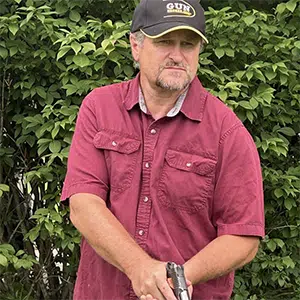
Ken Campbell now runs Gunsite as president. He’s worked hard to continue Gunsite’s legacy, understanding that regardless of skill, everyone can learn more and get better.
“The most important thing is to have an open mind and to seek out valid training,” said Campbell.
He recommends determining the purpose of a gun—hunting, home defense, concealed carry—as well as the skill level desired. Then, find a reputable trainer to reach goals by starting slowly and working up.
Gunsite offers a variety of pistol classes, along with rifle, carbine and more, with the 250 Defensive Pistol being the standard starting class. Over five-days of instruction, attendees learn marksmanship, gun handling and mindset. Now, skill levels will range after the class, but, according to Campbell, all students should be able to perform a bare minimum gun skills test.
This test consists of being able to draw and fire one round in the head from 5 yards in 1.5 seconds, and draw and fire two rounds center mass from 5 yards in 1.5 seconds. Times increase with distance.
Students obviously learn other skills, such as flashlight techniques and situational awareness, but these drills simulate one of the most common defensive scenarios.
Low Round Drill
Another simple guns skills test comes from Tom Givens, owner of Rangemaster Firearms Training Services. This drill works on several skills in a very brief exercise at 6 yards. It even has scoring levels explaining the bare minimum of which shooters should be capable, as well as expert level.
The drill requires a silhouette target with center mass circle, a head circle and a 2-inch circle by one or both shoulders, such as the RFTS-Q silhouette target. IDPA cardboard targets can be used by adding a 2-inch circle to a shoulder.
Start with a holstered and concealed handgun. At the signal, draw and fire three rounds center mass, two rounds to the head and one to the shoulder. Use a shot timer or friend with a stopwatch to determine time. Run the drill three times and add times together. All 18 rounds must hit inside each target circle, or shooters are disqualified and must start again.
According to Givens, average shooters should perform the drill in under 30 seconds. Trained shooters should do it in 18 seconds and experts in 15 seconds. This gun skills test measures concealed presentation, cadence and two transitions—a vertical and horizontal—with an accountability requirement.
Failure Reload
The final gun skills test is a variation of the Failure Drill. Col. Cooper, of Gunsite, designed the Failure Drill as an assessment drill, but it has morphed into a tactical. Originally, shooters drew and fired two shots center mass, before assessing the situation and ending the fight with a head shot. Today, shooters draw and fire two center mass and one to the head as quickly as possible. A good shooter can do it in three seconds.
In my variation, shooters start with three rounds in the gun to fire two round center mass and one the head before performing a slide-lock reload and doing it again. The average shooter should be able to perform this drill in 12 seconds with experts doing it in single digits. This drill tests speed accuracy, transitions and reloads. I’m a big believer in being able to quickly perform a reload.
The Bare Minimum
There are quite a few other drills that help determine one’s skill level. Most work well with a partner with whom a friendly competition can begin. It doesn’t really matter how you work drills, as long as you perform them correctly with the goal of getting better.
Accuracy is important, but accuracy in a situation is crucial. Drills can’t truly create the stress of an attack, but they are the best method for most shooters, particularly when adding the element of time. Train like the real world and maybe you’ll be ready if something happens.
By Paul Rackley, GunBroker Editor



![Features of the New KelTec PR-5.7™ Compact Concealed Carry [Video]](https://content.gunbroker.com/wp-content/uploads/2025/02/Keltec-PR57-featured-400x267.jpg)
![The Transformed LTT PX4 GSD and PX4 Compact [Video]](https://content.gunbroker.com/wp-content/uploads/2025/03/PX4_PX4-COMPACT-1200-X-800-400x267.png)
![Ruger RXM Handgun: A New Era of Precision and Performance [Video]](https://content.gunbroker.com/wp-content/uploads/2025/04/Ruger_RXM-2-1200-x-800-400x267.jpg)