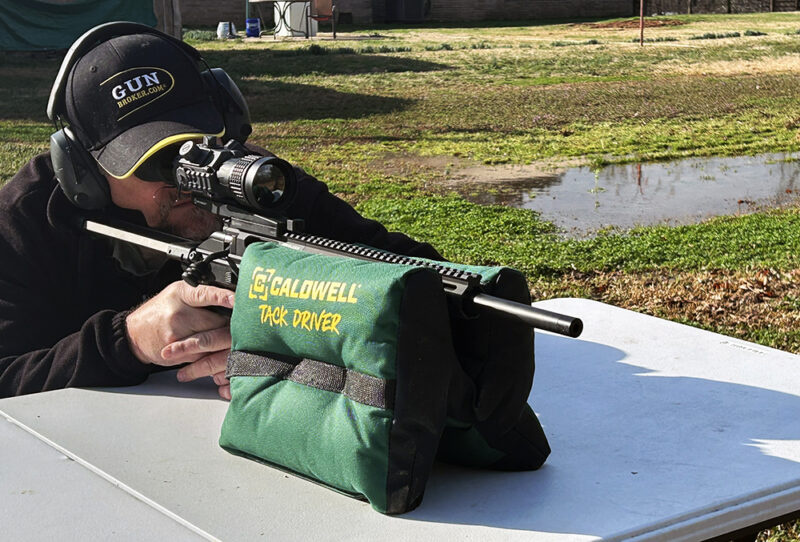
When thermal optics first came became known to the general public, lots of misinformation came out as well. This was mostly due to Hollywood playing fast and loose with the truth.
Movie scenes showed thermals penetrating through stone, wood and glass to show people walking around inside compounds and houses and sitting inside cars from quite a distance. And while thermal technology has made great strides, it hasn’t reached that level heat detection. At least not in civilian hands.
Thermals are, however, better than ever before. They are also much more affordable, putting thermals into use in numerous fields. This includes plumbing, electrical, medical and architecture. Thermals have really changed the world of search and rescue, self-defense and especially hunting.
Armasight Thermal Optics
Armasight got its start back in 2011 as a night-vision manufacturer. It quickly became a supplier of military and law enforcement agencies. It wasn’t long before the company got into making thermal products, bringing out one of the first commercially available thermal rifle sights. Of course, it had some issues along the way.
In 2016, FLIR Systems bought Armasight and created Outdoor & Tactical Systems. This new division introduced quite a few products, many of which were rather successful. These thermal devices were expensive, but they worked well. However, FLIR, for whatever reason, shut down Outdoor & Tactical Systems in 2016.
Luckily, the company came back in 2020, once again creating thermal and night vision optics and equipment for military, law enforcement and commercial markets. These include thermal rifle sights, monoculars and clip-ons, as well as night vision sights, monoculars and goggles.
I’ve long been curious about thermal optics, as I’ve had questions about both their effectiveness and practicality. Basically, do thermal optics work, and are they worth the price? Sure, prices on thermal optics have dropped a great deal in recent years, but they still can share a price with a custom rifle.
Armasight Collector 320 1.5-6×19
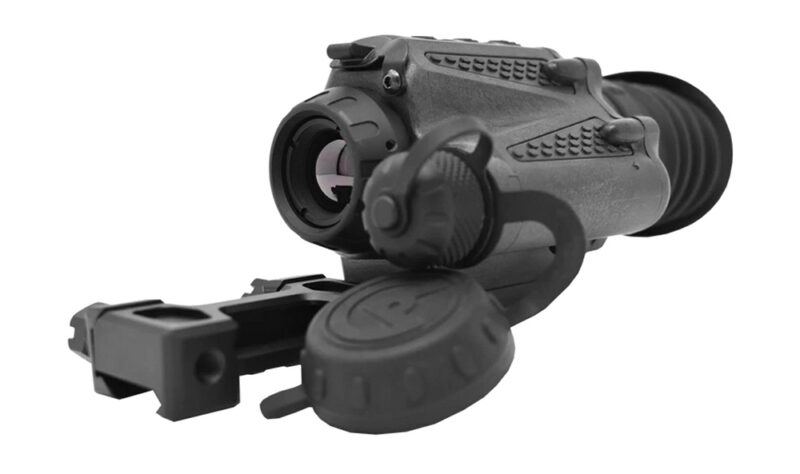
Available in two models, the Armasight Collector series is designed for shorter ranges. This includes rimfires, airguns, crossbows and, of course, ARs. Because of this, I attached a Collector 320 to my DPMS in 5.56. This was after playing with it off rifle, checking out the heat signatures of various cats, dogs, horses and other animals running around the farm, both at night and during the day.
It was fairly easy to figure out the three control buttons on top of the unit. I would recommend, though, to keep the manual handy, especially at first. It might not be a bad idea to carry that booklet for a while; I didn’t take the Collector out the door without the manual, even after I mostly understood its controls.
The specifications on the Collector claim a detection range out to 708 meters, recognition of 177 meters and an identification range at just over 100 meters. This is basically a more technical way of saying that the heat of something alive shows up from quite a distance. However, it is just going to be a heat blob until it get closer, where eventually, details will emerge. The claims were pretty accurate. In fact, detection seemed understated.
Armasight Contractor 640 3-12×50
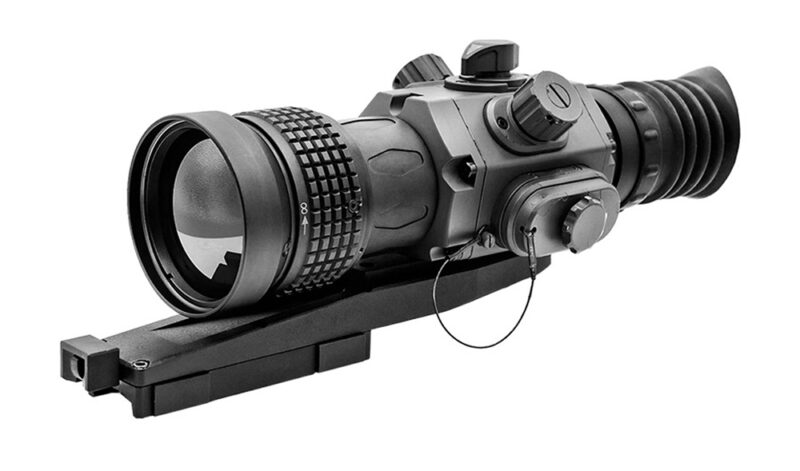
The Contractor, another Armasight thermal optic, is more powerful for viewing targets at longer distances on larger rifles. It can, in fact, handle up to the recoil of a .50 caliber; I put it on a .300 Blackout. The Contractor also comes with 3.2 optical magnification, along with a 1-4X digital zoom. This gives it a detection range of 1,865 meters, more than double that of the Collector. To do this, the Contractor is larger, heavier and more expensive.
The extension of distance Is obvious. The controls on this Armasight thermal optic are also a little different. It uses a knob that actually made its use easier. Just like with the Collector, I spent significant time on this thermal before attaching it to a rifle. This included going through the multiple color palettes and reticle options. I even played around with the photo and video capabilities, which are surprisingly good and very easy to use. You only have to push a single button to start recording. Another push of the same button stops the recording.
Despite control and power differences, both Armasight thermal optics were easy to set and use. It was really interesting to see varying heat levels. These devices show the heat signature of everything that is not blocked by trees, buildings or other solid objects. I was even able pick up larger animals in the woods from a pretty good distance. The thermal capabilities are excellent in both units. The best part of them, however, is the useability. It just takes a little while to figure them out, then it is pretty instinctive.
Armasight Thermal Optics: Range Work
Mounting the Collector was beyond easy, as it comes with a Picatinny mount. One simply has to determine where it needs to go for the eye to reach the cup and tighten the bolts.
It was just as easy to sight in. Armasight Thermal Optics come with a Thermal Zeroing Target, which shows up in the optic even in daylight. Since I wasn’t sure how many shots it would take to get zero, I actually started with a small square of aluminum foil at 25 yards.
The first shot with the Collector hit about 6 inches left and about an inch low. To sight in the optic, the instructions explain how to put it into Boresight mode. Then, keeping the reticle on the point of aim, adjust the windage and elevation of the orange X to the impact point on the target. Save the adjustment and fire again. The second round hit the center. Setting up at 100 yards with the included target showed the same results.
The Contractor sights-in the same, just with finer adjustments. Having a better understanding of how it works, I used the included Thermal Zeroing Target from the beginning. Once again it took three shots to put the reticle on the point of aim. I shot a few extras for fun and to be sure. My three shot group at 100 yards measured .81 inches.
Observations in Thermal
While thermals can be used during the day, these devices were designed for the night. As such, I took them out at night after coyotes. Despite some effort, I was unable to bring one out of the woods and into range. I did observe a whole lot of cow behavior after dark.
I also noticed the varying levels of heat from the world, from grass and trees to small animals. If it was within detection range, it stood out differently in the viewer. Just sitting on the porch looking watching the world go by through was actually quite fun. I even used the Collector to check heat in the walls when I had an electrical issue in the house.
I was able to try out these Armasight thermal optics for a few months. This was long enough to determine that, yes, thermals work. I also determined that thermals are worth the price. This is especially true for those who spend time in the woods at night chasing coyotes and hogs. Or really anyone who wants to observe what goes bump in the night.
And it is more than just the cool factor, which is, admittedly, pretty high. Thermal optics are useful for a variety of reasons beyond hunting and defense. Both the Collector and Contractor series from Armasight do everything advertised and more. These thermals are not cheap, but cheap doesn’t always do the job. Armasight thermal optics do.




![What’s New for 2025 From Meprolight? [Video]](https://content.gunbroker.com/wp-content/uploads/2025/02/meprolight-video-featured-400x267.jpg)
![Introducing the Meprolight MVO Rifle Optics (Magnified Optics) | New for 2025 [Video]](https://content.gunbroker.com/wp-content/uploads/2025/02/Mepro-MVO-rifle-optics_1-400x267.jpg)